# Data Preparation

### Joining different datasets by a common column&#x20;

<table data-full-width="false"><thead><tr><th align="center">CARTO DW</th><th width="154" align="center">BigQuery</th><th align="center">Snowflake</th><th align="center">Redshift</th><th align="center">PostgreSQL</th><th data-hidden>Snowflake</th><th data-hidden>Redshift</th><th data-hidden>PostgreSQL</th><th data-hidden>CARTO DW</th></tr></thead><tbody><tr><td align="center"><span data-gb-custom-inline data-tag="emoji" data-code="2705">✅</span></td><td align="center"><span data-gb-custom-inline data-tag="emoji" data-code="2705">✅</span></td><td align="center"><span data-gb-custom-inline data-tag="emoji" data-code="2705">✅</span></td><td align="center"><span data-gb-custom-inline data-tag="emoji" data-code="2705">✅</span></td><td align="center"><span data-gb-custom-inline data-tag="emoji" data-code="2705">✅</span></td><td></td><td></td><td></td><td></td></tr></tbody></table>

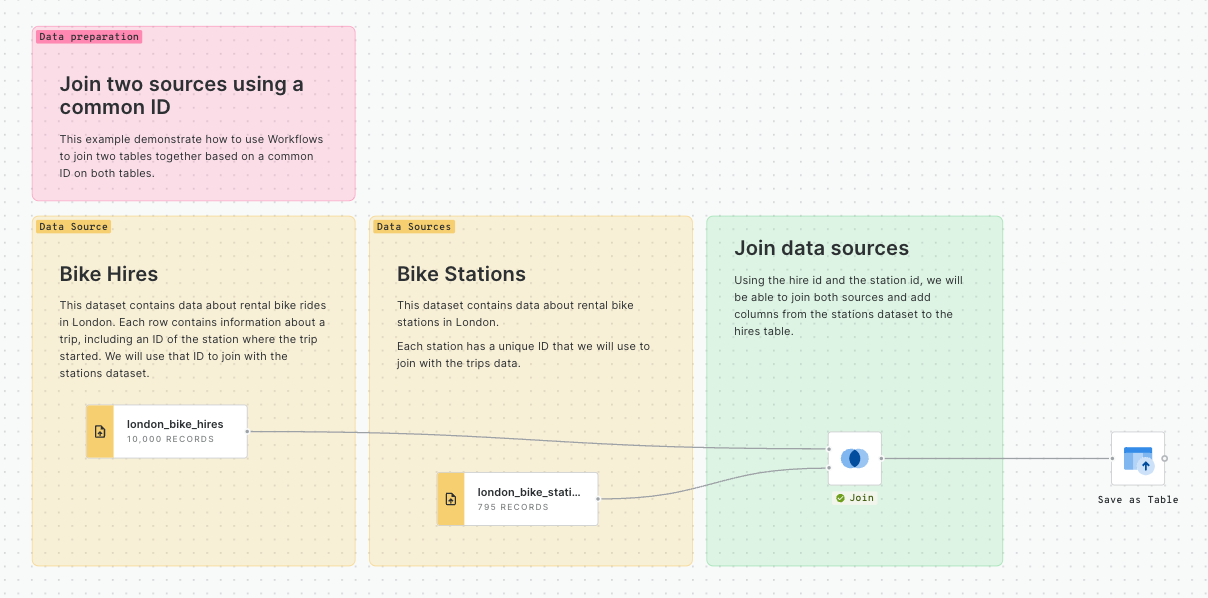
This example demonstrates how to use Workflows to join two tables based on a common ID on both tables.&#x20;

[**Download example**](https://storage.googleapis.com/carto-workflows-examples/files/join.sql)

<div align="left"><figure><img src="https://content.gitbook.com/content/FEElAdsRIl9DzfMhbRlB/blobs/2m0UKtXhcakblYsUmcKl/Screenshot%202023-10-17%20at%2017.18.04.png" alt="" width="563"><figcaption></figcaption></figure></div>

### Join two datasets and group by a property

<table data-full-width="false"><thead><tr><th align="center">CARTO DW</th><th width="154" align="center">BigQuery</th><th align="center">Snowflake</th><th align="center">Redshift</th><th align="center">PostgreSQL</th><th data-hidden>Snowflake</th><th data-hidden>Redshift</th><th data-hidden>PostgreSQL</th><th data-hidden>CARTO DW</th></tr></thead><tbody><tr><td align="center"><span data-gb-custom-inline data-tag="emoji" data-code="2705">✅</span></td><td align="center"><span data-gb-custom-inline data-tag="emoji" data-code="2705">✅</span></td><td align="center"><span data-gb-custom-inline data-tag="emoji" data-code="2705">✅</span></td><td align="center"><span data-gb-custom-inline data-tag="emoji" data-code="2705">✅</span></td><td align="center"><span data-gb-custom-inline data-tag="emoji" data-code="2705">✅</span></td><td></td><td></td><td></td><td></td></tr></tbody></table>

This example shows how to use Workflows to join two tables together and then group by a specific property, producing aggregated data coming from both sources.

[**Download example**](https://storage.googleapis.com/carto-workflows-examples/files/join_and_group_by.sql)

<div align="left"><figure><img src="https://content.gitbook.com/content/FEElAdsRIl9DzfMhbRlB/blobs/7QCoqfiRPEjESqribPwz/Screenshot%202023-10-17%20at%2017.37.20.png" alt="" width="563"><figcaption></figcaption></figure></div>

### Union of two data sources with same schema&#x20;

<table data-full-width="false"><thead><tr><th align="center">CARTO DW</th><th width="154" align="center">BigQuery</th><th align="center">Snowflake</th><th align="center">Redshift</th><th align="center">PostgreSQL</th><th data-hidden>Snowflake</th><th data-hidden>Redshift</th><th data-hidden>PostgreSQL</th><th data-hidden>CARTO DW</th></tr></thead><tbody><tr><td align="center"><span data-gb-custom-inline data-tag="emoji" data-code="2705">✅</span></td><td align="center"><span data-gb-custom-inline data-tag="emoji" data-code="2705">✅</span></td><td align="center"><span data-gb-custom-inline data-tag="emoji" data-code="2705">✅</span></td><td align="center"><span data-gb-custom-inline data-tag="emoji" data-code="2705">✅</span></td><td align="center"><span data-gb-custom-inline data-tag="emoji" data-code="2705">✅</span></td><td></td><td></td><td></td><td></td></tr></tbody></table>

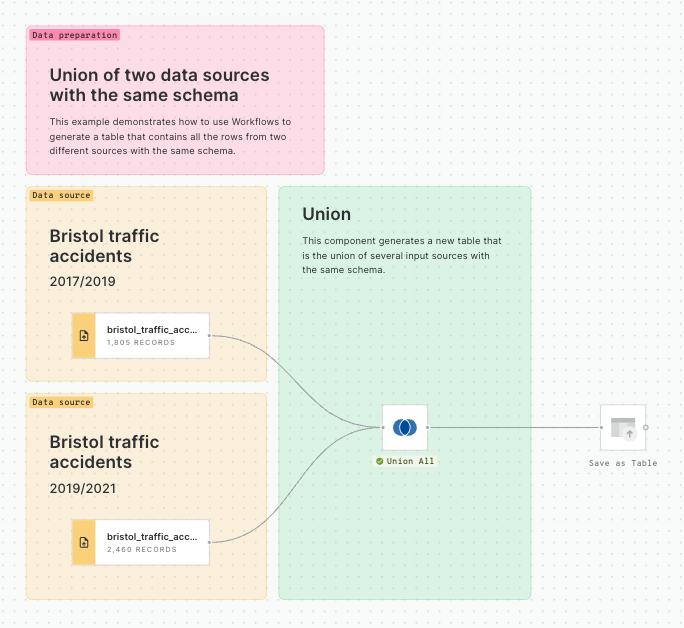
This example demonstrates how to use Workflows to generate a table that contains all the rows from two different sources with the same schema.

[**Download example**](https://storage.googleapis.com/carto-workflows-examples/files/union.sql)

<div align="left"><figure><img src="https://content.gitbook.com/content/FEElAdsRIl9DzfMhbRlB/blobs/3nvgOWfvXwRs4O7eXeq2/Screenshot%202023-10-20%20at%2016.32.45.png" alt="" width="342"><figcaption></figcaption></figure></div>

### Filter rows using a custom geography&#x20;

<table data-full-width="false"><thead><tr><th align="center">CARTO DW</th><th width="154" align="center">BigQuery</th><th align="center">Snowflake</th><th align="center">Redshift</th><th align="center">PostgreSQL</th><th data-hidden>Snowflake</th><th data-hidden>Redshift</th><th data-hidden>PostgreSQL</th><th data-hidden>CARTO DW</th></tr></thead><tbody><tr><td align="center"><span data-gb-custom-inline data-tag="emoji" data-code="2705">✅</span></td><td align="center"><span data-gb-custom-inline data-tag="emoji" data-code="2705">✅</span></td><td align="center"><span data-gb-custom-inline data-tag="emoji" data-code="2705">✅</span></td><td align="center"><span data-gb-custom-inline data-tag="emoji" data-code="2705">✅</span></td><td align="center"><span data-gb-custom-inline data-tag="emoji" data-code="2705">✅</span></td><td></td><td></td><td></td><td></td></tr></tbody></table>

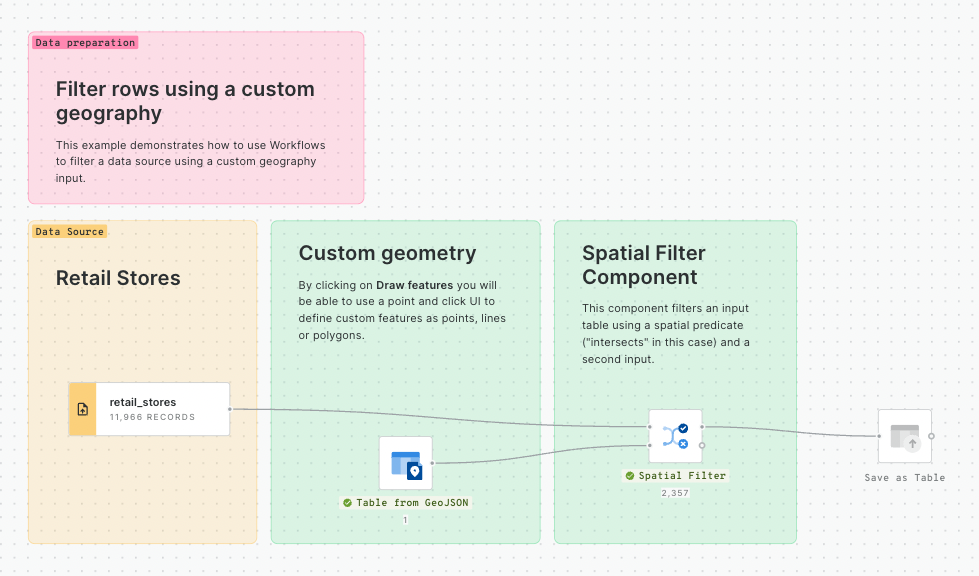
This example demonstrates how to use Workflows to filter a data source using a custom geography input.

[**Download example**](https://storage.googleapis.com/carto-workflows-examples/files/custom_geo_filter.sql)

<div align="left"><figure><img src="https://content.gitbook.com/content/FEElAdsRIl9DzfMhbRlB/blobs/zDvJ39SN5h2cnOFfWxx7/Screenshot%202023-10-20%20at%2016.52.18.png" alt="" width="563"><figcaption></figcaption></figure></div>

### Generate a calculated column from a multi-column formula&#x20;

<table data-full-width="false"><thead><tr><th align="center">CARTO DW</th><th width="154" align="center">BigQuery</th><th align="center">Snowflake</th><th align="center">Redshift</th><th align="center">PostgreSQL</th><th data-hidden>Snowflake</th><th data-hidden>Redshift</th><th data-hidden>PostgreSQL</th><th data-hidden>CARTO DW</th></tr></thead><tbody><tr><td align="center"><span data-gb-custom-inline data-tag="emoji" data-code="2705">✅</span></td><td align="center"><span data-gb-custom-inline data-tag="emoji" data-code="2705">✅</span></td><td align="center"><span data-gb-custom-inline data-tag="emoji" data-code="2705">✅</span></td><td align="center"><span data-gb-custom-inline data-tag="emoji" data-code="2705">✅</span></td><td align="center"><span data-gb-custom-inline data-tag="emoji" data-code="2705">✅</span></td><td></td><td></td><td></td><td></td></tr></tbody></table>

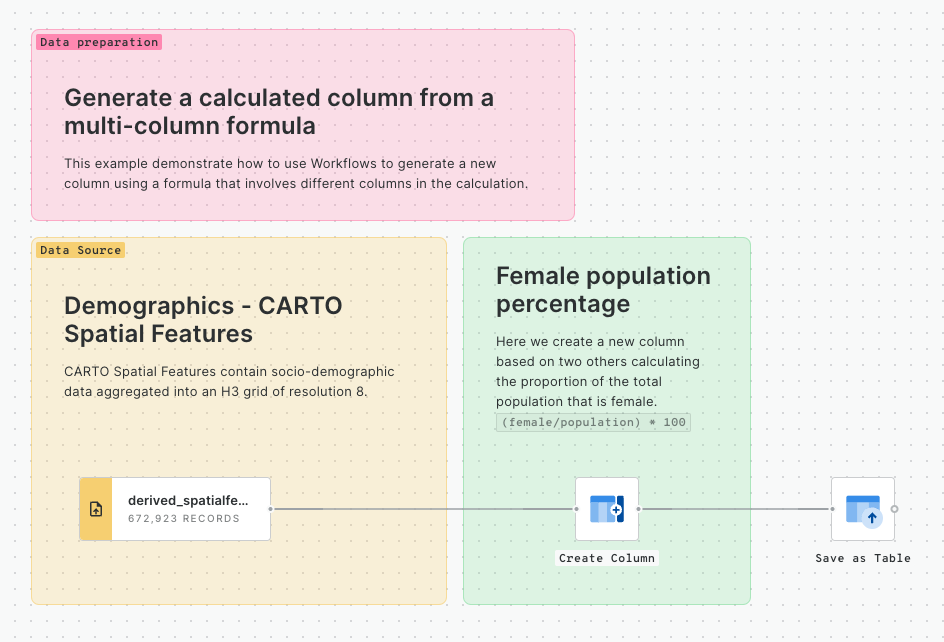
This example demonstrates how to use Workflows to generate a new column using a formula that involves different columns in the calculation.

[**Download example**](https://storage.googleapis.com/carto-workflows-examples/files/multi-column_formula.sql)

<div align="left"><figure><img src="https://content.gitbook.com/content/FEElAdsRIl9DzfMhbRlB/blobs/H4LGHkkmTDPV0qDk5WTa/Screenshot%202023-10-17%20at%2018.03.27.png" alt="" width="375"><figcaption></figcaption></figure></div>

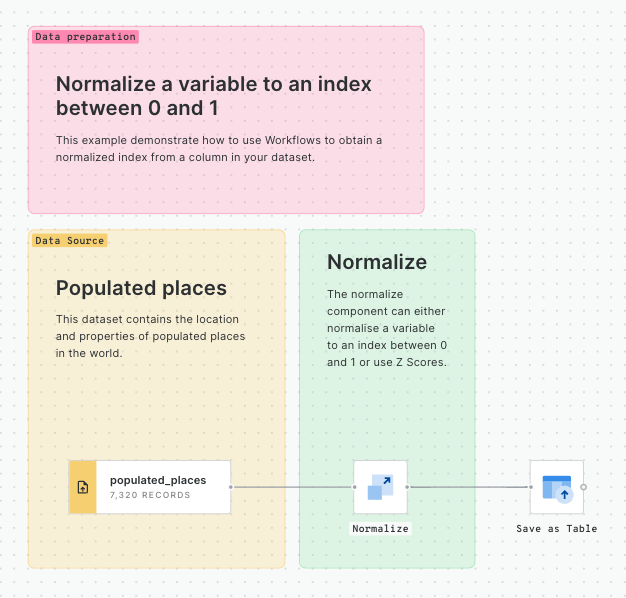
### Normalize a variable to an index between 0 and 1

<table data-full-width="false"><thead><tr><th align="center">CARTO DW</th><th width="154" align="center">BigQuery</th><th align="center">Snowflake</th><th align="center">Redshift</th><th align="center">PostgreSQL</th><th data-hidden>Snowflake</th><th data-hidden>Redshift</th><th data-hidden>PostgreSQL</th><th data-hidden>CARTO DW</th></tr></thead><tbody><tr><td align="center"><span data-gb-custom-inline data-tag="emoji" data-code="2705">✅</span></td><td align="center"><span data-gb-custom-inline data-tag="emoji" data-code="2705">✅</span></td><td align="center"><span data-gb-custom-inline data-tag="emoji" data-code="2705">✅</span></td><td align="center"><span data-gb-custom-inline data-tag="emoji" data-code="2705">✅</span></td><td align="center"><span data-gb-custom-inline data-tag="emoji" data-code="2705">✅</span></td><td></td><td></td><td></td><td></td></tr></tbody></table>

This example demonstrates how to use Workflows to obtain a normalized index from a column in your dataset.

[**Download example**](https://storage.googleapis.com/carto-workflows-examples/files/normalize.sql)

<div align="left"><figure><img src="https://content.gitbook.com/content/FEElAdsRIl9DzfMhbRlB/blobs/WbLkq95kVWNJbIGMhJz1/Screenshot%202023-10-17%20at%2018.10.59.png" alt="" width="313"><figcaption></figcaption></figure></div>

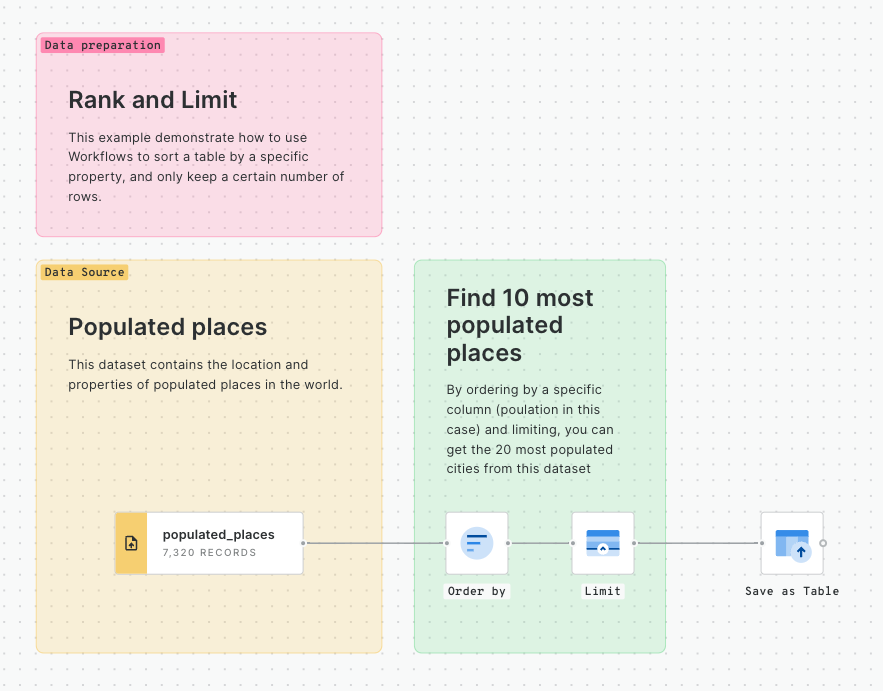
### Rank and limit a table&#x20;

<table data-full-width="false"><thead><tr><th align="center">CARTO DW</th><th width="154" align="center">BigQuery</th><th align="center">Snowflake</th><th align="center">Redshift</th><th align="center">PostgreSQL</th><th data-hidden>Snowflake</th><th data-hidden>Redshift</th><th data-hidden>PostgreSQL</th><th data-hidden>CARTO DW</th></tr></thead><tbody><tr><td align="center"><span data-gb-custom-inline data-tag="emoji" data-code="2705">✅</span></td><td align="center"><span data-gb-custom-inline data-tag="emoji" data-code="2705">✅</span></td><td align="center"><span data-gb-custom-inline data-tag="emoji" data-code="2705">✅</span></td><td align="center"><span data-gb-custom-inline data-tag="emoji" data-code="2705">✅</span></td><td align="center"><span data-gb-custom-inline data-tag="emoji" data-code="2705">✅</span></td><td></td><td></td><td></td><td></td></tr></tbody></table>

This example demonstrates how to use Workflows to sort a table by a specific property, and only keep a certain number of rows.

[**Download example**](https://storage.googleapis.com/carto-workflows-examples/files/rank_and_limit.sql)

<div align="left"><figure><img src="https://content.gitbook.com/content/FEElAdsRIl9DzfMhbRlB/blobs/f8FU1lzYf9vspRjTN8h1/Screenshot%202023-10-17%20at%2016.52.03.png" alt="" width="375"><figcaption></figcaption></figure></div>

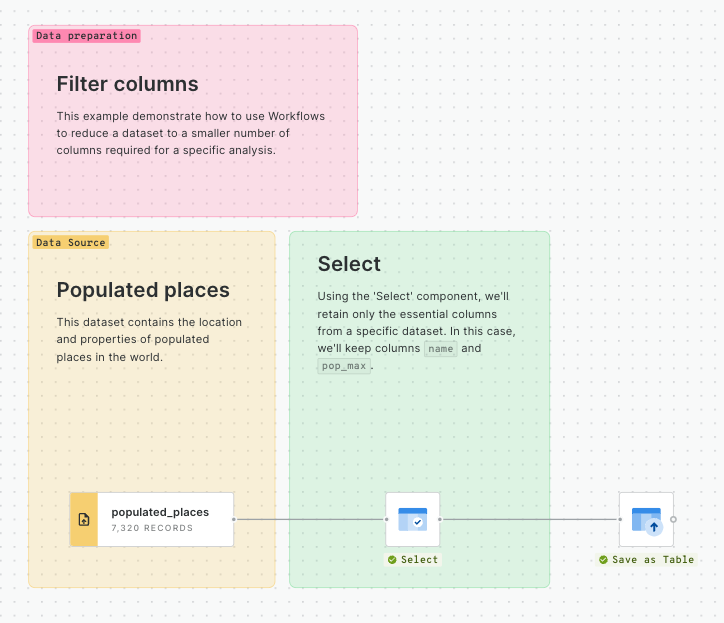
### Filter columns&#x20;

<table data-full-width="false"><thead><tr><th align="center">CARTO DW</th><th width="154" align="center">BigQuery</th><th align="center">Snowflake</th><th align="center">Redshift</th><th align="center">PostgreSQL</th><th data-hidden>Snowflake</th><th data-hidden>Redshift</th><th data-hidden>PostgreSQL</th><th data-hidden>CARTO DW</th></tr></thead><tbody><tr><td align="center"><span data-gb-custom-inline data-tag="emoji" data-code="2705">✅</span></td><td align="center"><span data-gb-custom-inline data-tag="emoji" data-code="2705">✅</span></td><td align="center"><span data-gb-custom-inline data-tag="emoji" data-code="2705">✅</span></td><td align="center"><span data-gb-custom-inline data-tag="emoji" data-code="2705">✅</span></td><td align="center"><span data-gb-custom-inline data-tag="emoji" data-code="2705">✅</span></td><td></td><td></td><td></td><td></td></tr></tbody></table>

This example demonstrates how to use Workflows to reduce a dataset to a smaller number of columns required for a specific analysis..

[**Download example**](https://storage.googleapis.com/carto-workflows-examples/files/filter_columns.sql)

<div align="left"><figure><img src="https://content.gitbook.com/content/FEElAdsRIl9DzfMhbRlB/blobs/b1KaOznqQScfHuwPL6DO/Screenshot%202023-10-17%20at%2017.53.10.png" alt="" width="362"><figcaption></figcaption></figure></div>


---

# Agent Instructions: Querying This Documentation

If you need additional information that is not directly available in this page, you can query the documentation dynamically by asking a question.

Perform an HTTP GET request on the current page URL with the `ask` query parameter:

```
GET https://academy.carto.com/creating-workflows/workflow-templates/data-preparation.md?ask=<question>
```

The question should be specific, self-contained, and written in natural language.
The response will contain a direct answer to the question and relevant excerpts and sources from the documentation.

Use this mechanism when the answer is not explicitly present in the current page, you need clarification or additional context, or you want to retrieve related documentation sections.